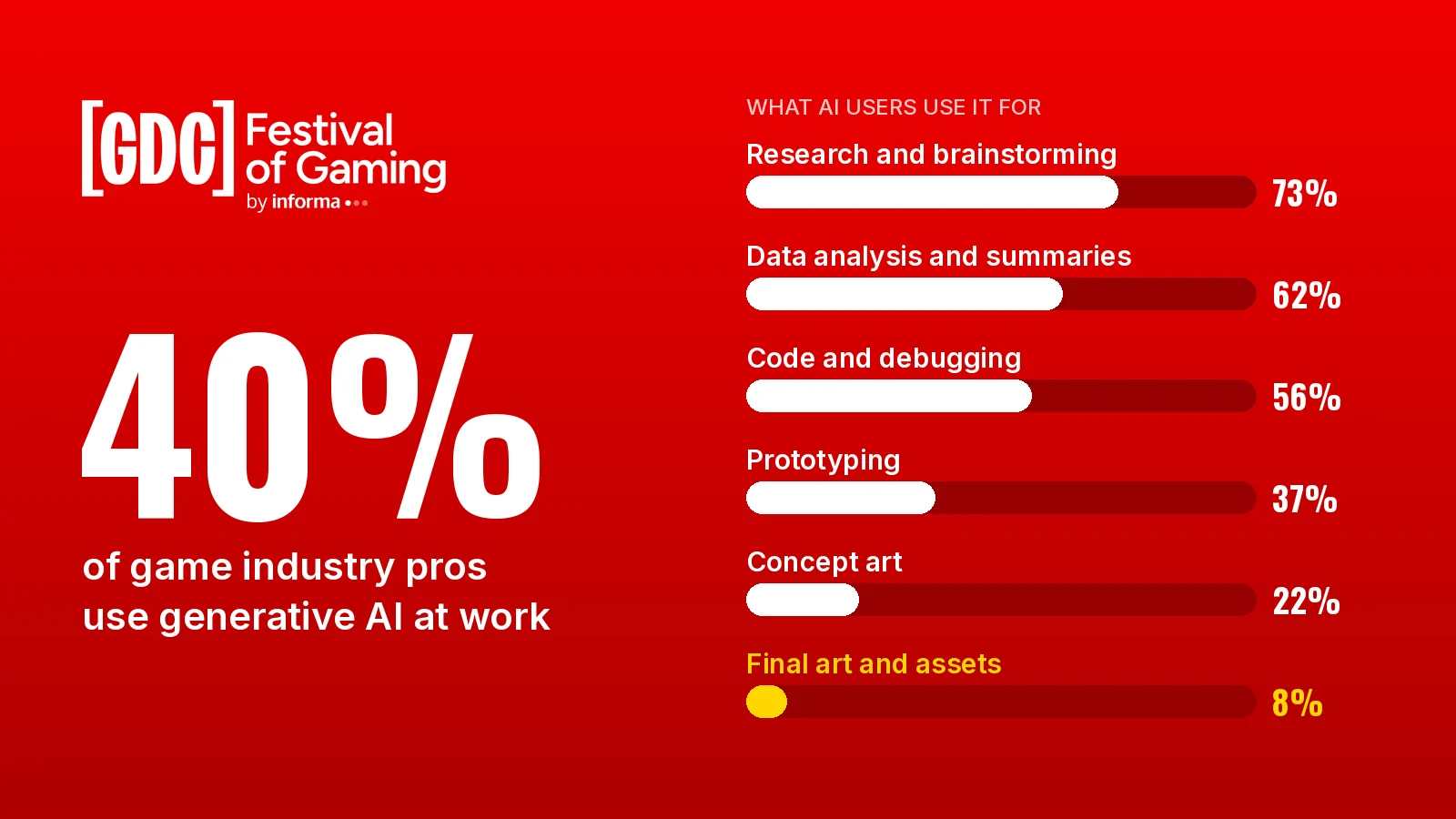
The loudest AI fights in games are about art, voices and slop. GDC’s new survey says that is the smallest slice of how developers actually use it. Most of the 40% who use generative AI treat it as a research desk and a debugging buddy, and very few let it near anything players see.
What GDC found
GDC Festival of Gaming published its State of the Game Industry report for November 2026 on November 12. It is based on more than 2,600 game industry professionals, a 12% jump in respondents from the last edition.
Forty percent said they use generative AI tools as part of their job, up from 36% last year. Of those users, 57% use it daily. Adoption is lopsided, reaching 70% at mobile-only studios and 58% on free-to-play games.
Sentiment barely moved. Fifty-five percent think generative AI is having a negative impact on the industry, against 54% last year, while 35% call it mixed and only 8% call it positive. QA and community support are the gloomiest groups at 76% negative. GDC’s Beth Elderkin told GamesBeat this was the first year the number did not shift, which suggests most people have already made up their minds.
What people actually use it for
Among AI users, 73% use it for research and brainstorming, 62% for data analysis and summaries, and 56% for code generation and debugging. Another 37% use it for prototyping.
Then the numbers drop off a cliff. Twenty-two percent use it for concept art, and 8% for production art or final game assets. Game Developer counted only 6% using it for player-facing content.
So the typical AI-using developer looks less like a prompt artist and more like someone asking a chatbot why the build broke again. That is a far less cinematic picture than the one in most arguments online.
GDC’s own summary notes “large opposition” to generative AI for creative or player-facing features. Respondents still worry about environmental impact, legal issues and job losses. A new worry showed up this year too, skill atrophy, the fear that leaning on the tools stops juniors from learning the craft.
Indies feel far less pressure than AAA
The pressure gap is stark. Twenty-seven percent of AAA workers feel encouraged or pressured to use generative AI, compared with 9% at indie studios. Some respondents said they dislike the tools but are made to use them at work.
It lands in a bleak report. A third of respondents were laid off in the past two years, 39% in the US, and 54% of them are still unemployed. GDC itself cautions that the survey likely draws more answers from people hit by layoffs than the industry as a whole.
For a small team, low pressure is a quiet advantage. You decide where AI fits, if anywhere, without a mandate from above. Indies are also drifting toward open tools, with 11% of respondents now at indie studios using Godot, up from 7%. If that is you, our Godot AI guide sorts the coding helpers by job.
Xbox is pitching something much bigger
The same day, Xbox CEO Asha Sharma posted a 25th anniversary essay on X that builds to an audacious line near the end. “A small team will be able to build worlds that today demand hundreds of developers and hundreds of millions of dollars,” she wrote.
She never wrote the word AI, but Polygon read it as a clear signal that Xbox studios will lean on it. Polygon also points out that in February she promised Xbox would not “flood our ecosystem with soulless AI slop.”
Put that next to the survey. Developers describe AI that researches, summarizes and fixes code. Xbox describes AI that builds worlds. Both can be true, but the distance between them is where most of the friction with players will live.
What this means if you make games
Use it where your peers do. Research, summaries, prototypes and debugging are the mainstream uses and the lowest risk. A chatbot that helps you find a bug ships nothing to players.
Treat player-facing assets as a separate decision. Only 8% of AI users make final assets with it, and the Big Walk fight shows players can react sharply even to tiny amounts of AI help in code. If AI content ends up in the build, plan it like a feature, with a reason you can explain in one sentence.
Know what Steam asks. Valve’s content survey says efficiency gains from AI tools are not the focus. It asks about AI content that ships with your game and is consumed by players, such as artwork, sound, narrative and localization. Disclose that honestly, and consider a short plain note on your store page even when the form does not require one.
Write your AI policy before anyone asks. A few lines on what you use and what you don’t take ten minutes today. Improvising them during a wave of negative reviews is a far more perilous exercise.
Keep the skills sharp. The skill atrophy worry is fair. If AI suggests code, read it until you understand it, and keep doing the parts you want to get better at by hand.
Start with free tools if you are curious. You don’t need a subscription to try research or prototyping help. Our free AI game dev tools guide lists options by job.